
From Global Governance to Local Action
From October 21st to 24th, the FAO headquarters in Rome hosted the 53rd Session of the Committee on World Food Security (CFS), bringing together governments, civil society, and experts to discuss the future of global food governance.
This year’s plenary session sent a clear message for the years ahead: a systemic transformation toward resilient, local food systems is essential to secure true food sovereignty. The session was shaped by the sobering findings of the State of Food Security and Nutrition in the World (SOFI) 2025 report, which revealed that about 673 million people worldwide faced chronic hunger in 2024—roughly 8.3% of the global population. A record-high 2.3 billion people experienced food insecurity over the same year, underscoring the urgent need for systemic transformation.

The Role of Civil Society and the CSIPM
Across the world, small scale farmers—often far from the centers of power that shape international trade— produce around 70% of all food consumed, yet they continue to bear the heaviest burdens of conflict, inequality, and environmental degradation. Responding to this reality, the Civil Society and Indigenous Peoples’ Mechanism (CSIPM) was established to bring the voices of those most affected by food insecurity, biodiversity loss, and resource depletion into the CFS process.
The CSIPM’s strength lies in its ability to unite non-profit organizations, rural and farming communities, and Indigenous peoples in shaping global food policy recommendations. This year, the mechanism expressed deep concern over the weaponization of food and the erosion of Indigenous peoples’ rights, as conflicts and corporate influence continue to strip communities of their ability to live from their own territories.
Through testimonies, case studies, and collaborative analysis, CSIPM showed how real communities—rural, peri-urban, and urban alike—are already leading transformation on the ground. Their work demonstrates that resilience begins locally, in the living relationships between people, land, and community self-governance.

Policy Directions: Resilience and Shared Responsibility
The policy recommendations adopted by the CFS on urban and peri-urban food systems mark an important step toward this transformation. They call for strengthening local food systems through equitable access to land, water, and housing; the promotion of circular economies; and the protection of both health and livelihoods. The CFS also recognized the central role of local governments and emphasized that communities must be equipped with fair and accessible financial instruments to ensure independence and resilience.
As highlighted by the High-Level Panel of Experts (HLPE) report, the future of food does not lie in corporate-controlled agribusiness but in small-scale farming, community participation, and local governance—systems that nourish both people and ecosystems rather than exploit them.
Linking Local Realities and Global Policy
It is therefore essential to strengthen the connection between local realities and global policy spaces, ensuring that the experiences of food sovereignty, agroecology, and community regeneration inform decision-making at every level.
Navdanya International, in line with CSIPM recommendations, continues its work to bridge these levels—bringing into international policy dialogues the living knowledge of communities that are regenerating their territories through participatory education and collective stewardship.
Over the years, community initiatives within urban and peri-urban food councils have fostered citizen engagement, local markets, and agroecological education. Through capacity-building programs, advocacy campaigns, and the educational pathway Ecoculturae, Navdanya International links global policy recommendations to tangible community practices, advancing food sovereignty from the ground up.
 Navdanya International’s Role: Bridging Local Practice and Global Policy
Within this broader context, Navdanya International aims to contribute to the CFS process not institutionally, but through relationships — grounded in lived experience and shared learning across continents. Our work grows from the ground: from communities cultivating biodiversity, regenerating soils, and reweaving relationships between food, culture, and territory. These experiences feed into international policy dialogues, offering evidence of how resilience is built in practice.
At the same time, through active participation in the Civil Society and Indigenous Peoples’ Mechanism (CSIPM) and international policy forums, Navdanya International helps bringing global frameworks back to the community level — translating them into place-based strategies for food sovereignty and ecological democracy. In this perspective , global policy spaces like the CFS become both mirrors and amplifiers of community experience.
Across our programmes, we work to connect the local to the global and the global back to the local. Through Terrae Vivae and Ecoculturae, we cultivate regenerative food systems and ecological literacy that directly reflect the CFS’s emphasis on urban and peri-urban food systems. Farmers’ markets, youth trainings, and participatory food councils are becoming models of how communities can design their own pathways to food security and climate adaptation.
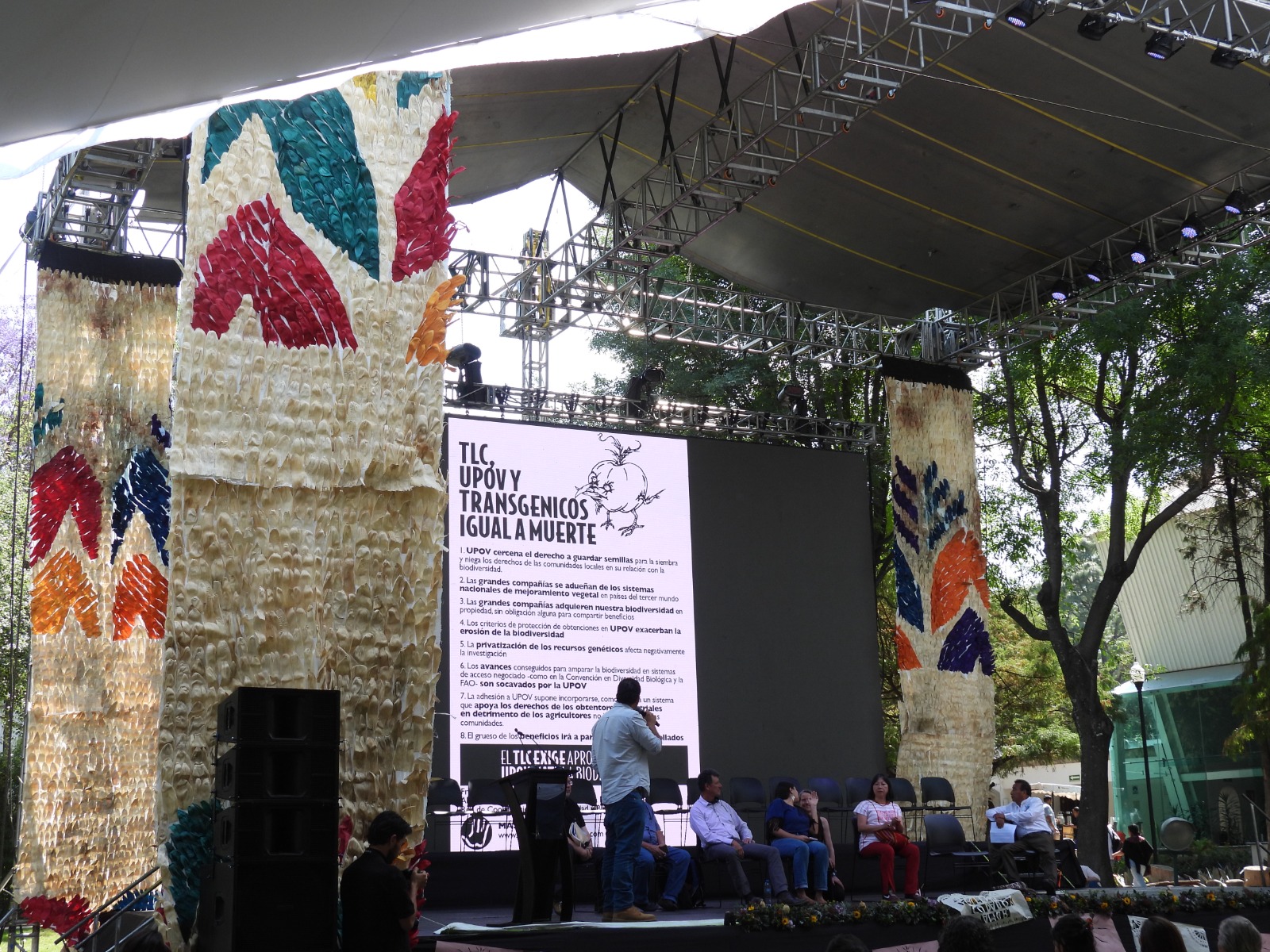
Meanwhile, Navdanya International’s international collaborations — from supporting Mexico’s defense of native maize and Indigenous food sovereignty movements such as the Wild Salmon Caravan in British Columbia, to advocating for biodiversity protection at COP16 — extend these same principles to global scale. Through such partnerships, we aim to demonstrate how local movements can shape the global discourse on climate, biodiversity, and food systems.
By weaving together these dimensions — education, advocacy, policy dialogue, and community action — Navdanya International fosters a living network of exchange and regeneration. Our work helps ensure that the principles of agroecology and food sovereignty are not confined to resolutions and reports, but embodied in the daily practices of communities everywhere.
Resilience, in this vision, is not a policy outcome but a process of relationship, reciprocity, and regeneration — a co-creation between people and the Earth.

From Terrae Vivae to Global Regeneration
This ongoing commitment is embodied in Navdanya International’s Terrae Vivae programme — a living network of regenerative communities fostering agroecological transitions. Together with its educational arm, Ecoculturae, the initiative cultivates ecological literacy, youth engagement, and community empowerment as the foundations of resilience.
As the CFS and CSIPM launched the new workstream on Resilient Food Systems, Navdanya International will continue contributing to this process by bringing forward the insights of Terrae Vivae and Ecoculturae — showing how agroecological practice, community participation, and ecological education create resilience not only in food systems but in the social and cultural fabric that sustains them. These grounded experiences offer tangible evidence of how communities regenerate their ecosystems while defending their right to food, land, and biodiversity.
In this shared vision, Terrae Vivae represents more than a programme: it is a living expression of the future that the CFS seeks to cultivate — one where local action and global policy co-evolve, rooted in care, reciprocity, and Earth democracy. By bridging local knowledge with global advocacy, Navdanya International demonstrates that resilience begins in communities — and food, ultimately, is not a commodity but a commons.